
Energy, Agriculture and Forestry — Long-Term Implications
Master the Moment and Reach Your Peak with Defoes
“Land-use competition between energy, agriculture and forestry will intensify over coming decades. Long-term resilience depends less on choosing a single use and more on building adaptive, well-evidenced strategies that anticipate shifting policy, climate conditions and resource demand.”
Land-use competition is not a temporary imbalance that markets will quietly resolve. World Resources Institute projections suggest that, on a business-as-usual path, agricultural land could expand by around 600 million hectares between 2010 and 2050, an area nearly twice the size of India, while meeting rising demand for wood could require harvesting roughly 800 million hectares of forest, comparable to the size of the continental United States. These figures are projections, not certainties, and depend heavily on policy, technology and consumption patterns. For investors and landowners, the relevant insight is structural: demand for land-intensive goods is on a rising long-term trajectory, and the resources available to meet it are fixed.
This dynamic reshapes long-term asset selection. Where competition intensifies, land with strong agricultural productivity, water security, energy-grid access or verified forest management may command a durable advantage over less flexible or poorly documented holdings. Modelling of long-term US land-use change shows that outcomes vary considerably by scenario: under higher-pressure conditions, cropland and pastureland can expand at the expense of managed forest, while lower-pressure scenarios show land used less intensively. This variability signals that long-term land value should be assessed against a plausible range of futures, not a single forecast. Clients should treat land-use projections as a framework for evaluating exposure and resilience, not as a guarantee of any particular outcome.
Policy will be a decisive long-term variable. Renewable-energy siting, agricultural subsidy structures, forest-carbon incentives, biodiversity regulation and climate-adaptation requirements are all likely to evolve, and each can alter the relative attractiveness of a given land use. Analysis of long-term investment decisions increasingly treats climate and land-use policy as a core risk factor requiring active monitoring, rather than a background consideration. Investors focused on multi-decade holding periods should expect regulatory frameworks governing land conversion, water rights, carbon accounting and renewable-energy siting to change materially over the life of an asset and should build flexibility into their strategies accordingly.
Climate change compounds this uncertainty. Shifting rainfall patterns, water stress, extreme weather and changing crop suitability are already altering which land supports which use, and modelling suggests this could accelerate structural shifts, such as row crops giving way to orchards or pasture in some US regions by 2050. Similar dynamics apply internationally, where drought and heat stress may reduce the viability of established agricultural or forestry practices. For long-duration real assets, this means today’s productive land classification cannot be assumed to hold indefinitely. Long-term strategies should factor in adaptive capacity: the ability of an asset, and the people managing it, to respond as growing conditions and demand patterns shift over time.
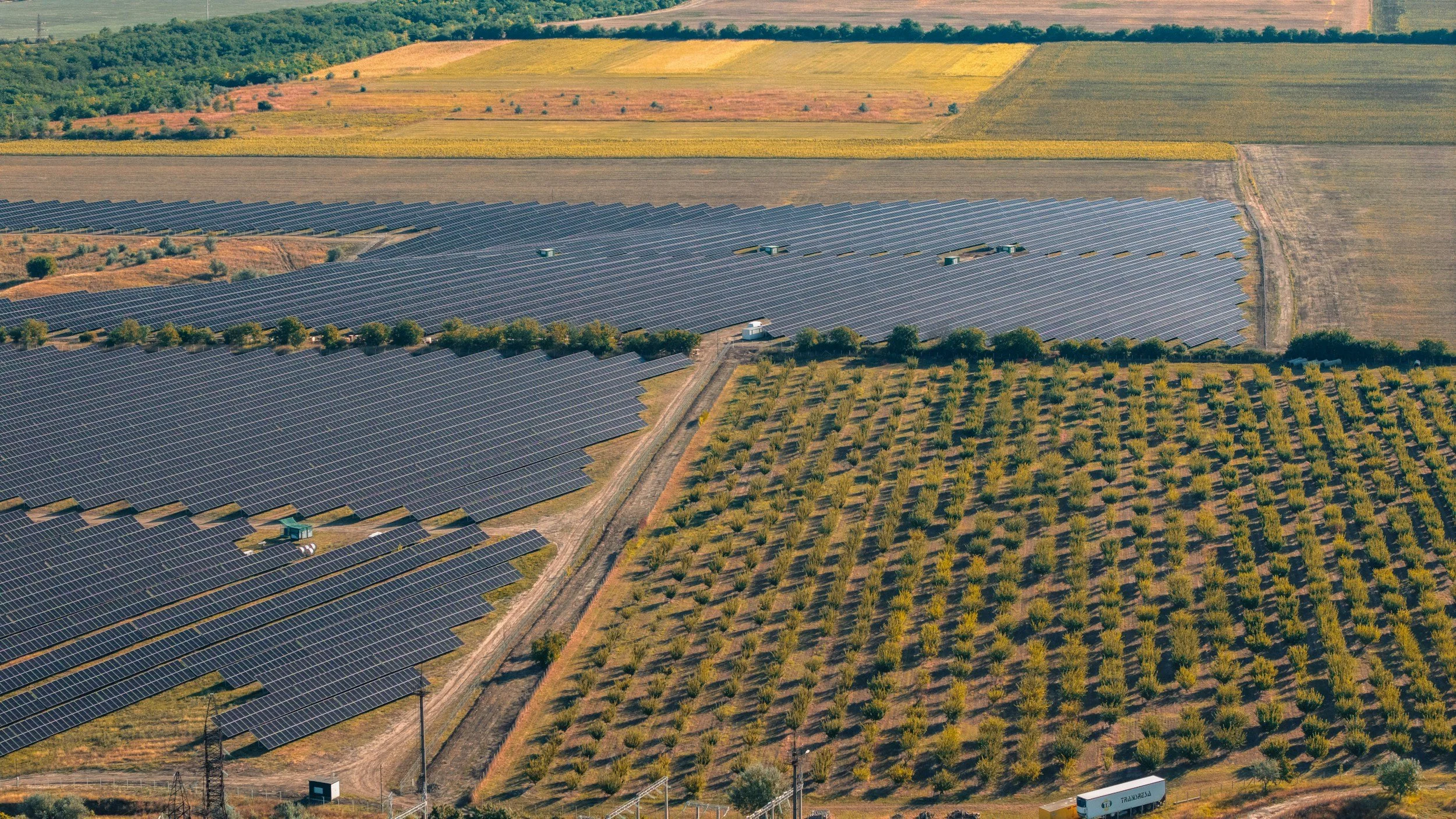
The long-term resolution favours integration over specialisation. Approaches that combine food production, forestry, restoration and renewable energy on the same landscape, where feasible, tend to show more resilience across future scenarios than single-use strategies that assume static demand. WRI’s “produce, protect, reduce, restore” framework illustrates this: raising productivity on existing land, protecting high-value ecosystems, moderating demand growth and restoring degraded land together reduce pressure across food, energy and forestry systems simultaneously. For clients, this reframes land as a portfolio of interdependent long-term functions rather than a single-purpose asset. Defoes supports this shift by helping clients evaluate land-use exposure against multiple future scenarios, assess regulatory and climate risk over realistic time horizons, and position capital with a clearer understanding of how competing demands may evolve. The result is not certainty about the future but a stronger foundation for long-term positioning amid a resource landscape that is becoming steadily more contested.
Disclaimer: The content provided herein is for general informational purposes only and does not constitute financial or investment advice. It is not a substitute for professional consultation. Investing involves risk, and past performance is not indicative of future results. We strongly encourage you to consult with qualified experts tailored to your specific circumstances. By engaging with this material, you acknowledge and agree to these terms.