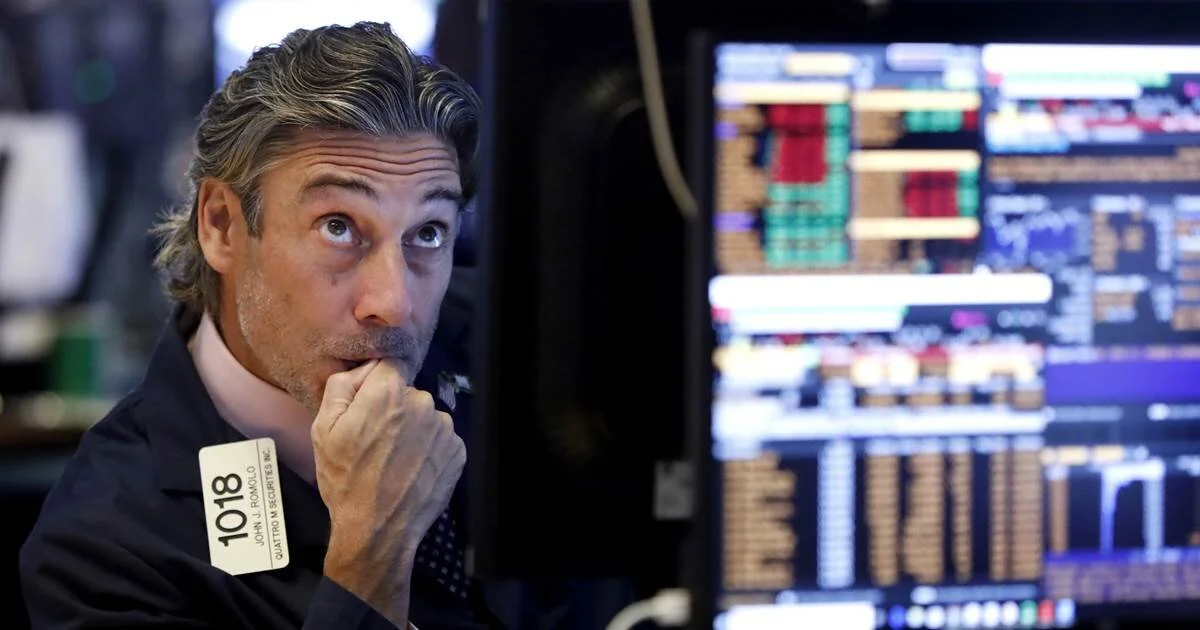
Economists expect growth in the fourth quarter to be about the same as the third quarter, at 2.1%, but growth could fall off going into the new year.
Fourth quarter gross domestic product data is expected Thursday at 8:30 a.m. ET.
Numbers should reflect less growth in spending in the fourth quarter, stubbornly soft business spending, and a surprise widening in the trade gap in December.
The central bank’s Federal Open Market Committee said Wednesday it will hold its benchmark funds rate in a range between 1.5% to 1.75%, where it has been since the latter part of last year.
The committee adjusted the language in its statement to reflect that policy is geared toward “inflation returning to the Committee’s symmetric 2 percent objective.”
The decision was unanimous. Several board members last year objected to the Fed’s rate cuts.
The Davos crowd doesn’t know where to allocate capital, says the vice chairman of British investment company Standard Life Aberdeen.
The current trend is to leave public markets and look to private investments.
Real estate, student accommodation and airports are all examples of what is in favor.
The Washington-based institution forecast in October a global growth rate of 3% for 2019 and of 3.4% for 2020.
The IMF has now revised down those forecasts to 2.9% and 3.3%, respectively.
The IMF is cautious about the state of the global economy going forward, in particular about further trade tensions.
The UK's economy grew by just 0.1% in the three months to November, according to the Office for National Statistics.
Growth was slightly stronger in September and October than previously thought, but fell 0.3% in November, dragging down the three-month figure.
The ONS said growth in the economy year-on-year was at its lowest since the spring of 2012.
Growth in construction was offset by a weakening service sector, while manufacturing was "lacklustre".
Read MoreAerospace and defense stocks typically outperform the S&P 500 in the six months after Middle East crisis events.
Defense stocks have climbed and the broader market has sold off following last week’s killing of Iranian military leader Qasem Soleimani.
Huntington Ingalls and General Dynamics are the two best-performing defense stocks on average following major crisis events.
Stocks fell on Friday after the U.S. confirmed that an airstrike killed Iran’s top military commander, sending oil prices surging and ratcheting up geopolitical concerns.
The Dow Jones Industrial Average closed 233.92 points lower, or 0.6% at 28,634.88 and posted its biggest one-day loss since early December. The S&P 500 also had its worst day in a month, sliding 0.7% to 3,234.85. The Nasdaq Composite dropped 0.8% to 9,020.77. The Dow briefly dropped more than 360 points at the open. The major averages recovered some ground later in the session as oil prices came off their lows.
Read MoreStocks and oil tend to outperform defensive assets like gold and Treasurys in the months after major crisis events in the Middle East, according to an analysis by CNBC.
A U.S. airstrike killed a key Iranian leader, sending oil and gold prices higher.
Major U.S. stock indexes opened lower after the strike.
“All of the pillars of the stock market look a bit shaky to me,” he told “Trading Nation” Thursday. “While the economy will be okay in 2020, I think the stock market will have a rougher go of it.”
While he cites consumer spending, household balance sheets, jobs growth and a housing market as economic bright spots, he also sees slower than expected real GDP growth, a growing federal budget deficit and challenged corporate earnings pressuring the economy.
Read MoreStocks rose to all-time highs on Thursday, led by tech shares, as the strong rally in 2019 continued in the first trading day of the new year.
The Dow Jones Industrial Average advanced 330.36 points, or 0.9% to 28,868.80 and notched its biggest one-day gain since Dec. 6. The S&P 500 closed 0.8% higher —marking its best performance since Dec. 12 — at 3,257.85. The Nasdaq Composite gained 1.3% to end at 9,092.19 and had is best day since Oct. 11. The major averages hit their session highs in the final minutes of trading.
Read MoreThe pound has risen sharply over the past month as currency traders in the City of London bet that an election victory for Boris Johnson’s Conservatives would lift some of the intense political uncertainty facing Britain. Sterling jumped by more than two cents against the US dollar and the euro after exit polls indicated a Tory majority.
Read MoreThe British economy is on track for the weakest year outside a recession since the second world war, as political turmoil and Brexit uncertainty dragged down growth, a Guardian analysis reveals.
At the end of a turbulent year and following Boris Johnson’s election victory, surveys of business activity suggest economic growth in the final three months of 2019 has essentially stalled. The jobs market is showing signs of stress and public borrowing is steadily rising again after a decade of improvement.
Read MoreA net 7% of stocks on the Nasdaq and New York Stock exchanges hit new 52-week highs last week, a bullish sign for the market.
Sentiment Trader said it was the most in six months, and the increase in highs is often a good longer-term signal for the market.
“It’s really a market firing on all cylinders. It’s such a key point here,” said one technical analyst, noting the breadth of the market has been improving.
What happens now?
Johnson was hoping to get his deal through on Saturday, when lawmakers were gearing up to vote on the deal in a rare weekend sitting. But that did not happen, as lawmakers instead voted on an amendment that withholds their support for any deal until separate legislation is passed that ensures that any deal must be implemented in U.K. law.
Singapore’s economy — often seen as a bellwether for global growth — avoided a technical recession after growing by 0.6% in the third quarter, compared to the previous three months.
That quarter-on-quarter expansion marked a reversal from the revised 2.7% decline in the April-to-June period, official advance estimates by the Ministry of Trade and Industry showed on Monday. On a year-on-year basis, Singapore’s economy grew 0.1% in the third quarter.
Read More